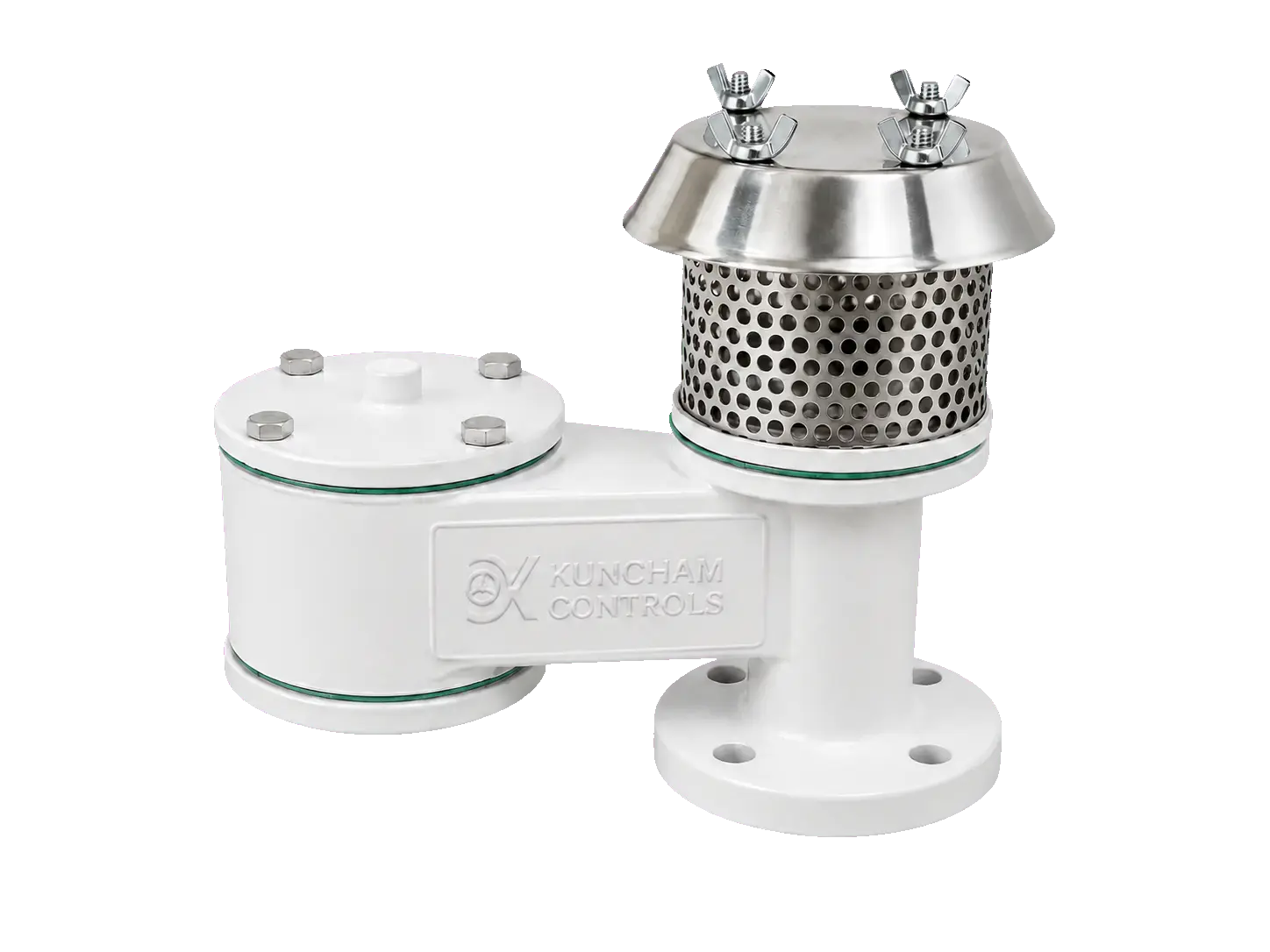
Industrial breather valves, also used as pressure-vacuum relief valves (PVRVs), help protect storage tanks against excessive internal pressure or vacuum while allowing controlled tank breathing during filling, emptying and thermal changes.
Breather Valves are designed to protect storage tanks and low-pressure vessels from excessive internal pressure or vacuum during filling, emptying and thermal expansion or contraction.
Weight-loaded or spring-loaded pressure / vacuum relief operation
Automatic tank breathing during filling, emptying and temperature changes
Breather Valves are designed to protect storage tanks and low-pressure vessels from excessive internal pressure or vacuum during filling, emptying and thermal expansion or contraction.
The valve operates through pressure and vacuum pallets that open automatically when the preset tank pressure or vacuum limit is reached. The required setting can be achieved using a counterweight / weight-loaded arrangement or spring-loaded mechanism, depending on the application.
Available with carbon steel, stainless steel and PTFE-coated body options, along with flanged, threaded or Tri-Clover connections, the breather valve can be configured for different tank and process requirements. For applications handling flammable vapours, a Breather Valve cum Flame Arrester configuration is available with a separate flame-arresting section.
How it works
Working Principle
Weighted pressure and vacuum elements remain seated during normal tank conditions. When internal pressure or vacuum reaches the configured threshold, the appropriate element opens to let vapour out or air in, then reseats as the condition normalises.
01
Tank pressure changes
Filling, emptying and thermal movement cause the pressure inside the storage tank to rise or fall.
02
Relief path opens
The pressure or vacuum element lifts when the selected setting is reached, allowing controlled outward or inward breathing.
03
Valve reseats
As tank pressure returns toward normal, the weight-loaded element closes to limit unnecessary venting.
At a glance
Key Highlights
Weight-loaded or spring-loaded pressure / vacuum relief operation
Automatic tank breathing during filling, emptying and temperature changes
Sizes from 1″ (DN25) to 8″ (DN200)
Design temperature up to 350°C
Flanged, threaded and Tri-Clover connection options
Carbon steel, stainless steel or PTFE-coated body options
Range summary
Technical Specifications
Values below summarise the product family. Open an individual product for its complete model and variant data.
Controlled pressure and vacuum breathing helps protect storage tanks during filling, emptying and temperature changes.
Pallet-based operation
Pressure and vacuum pallets can use weight-loaded or spring-loaded operation according to the required setting.
Material flexibility
Carbon steel, stainless steel and PTFE-coated body options support different tank services.
Combination option
A Breather Valve cum Flame Arrester is available when both controlled breathing and flame protection are required.
Support
Questions & Answers
Why is a Breather Valve used on a storage tank?
It provides controlled pressure and vacuum relief as the tank is filled, emptied or affected by temperature changes.
How does the Breather Valve operate?
Pressure and vacuum pallets open when the preset pressure or vacuum is reached. The loading can be weight-loaded or spring-loaded.
Does a standard Breather Valve contain a flame-arrester element?
No. The standard Breather Valve uses pallets and loading mechanisms. Select the combined Breather Valve cum Flame Arrester when flame-propagation protection is also required.
Which sizes are available?
The standard size range is 1 inch to 8 inches.
What information is needed for selection?
Provide the tank service, pressure and vacuum settings, vent size, temperature, connection, body material, vapour conditions and any flame-protection requirement.