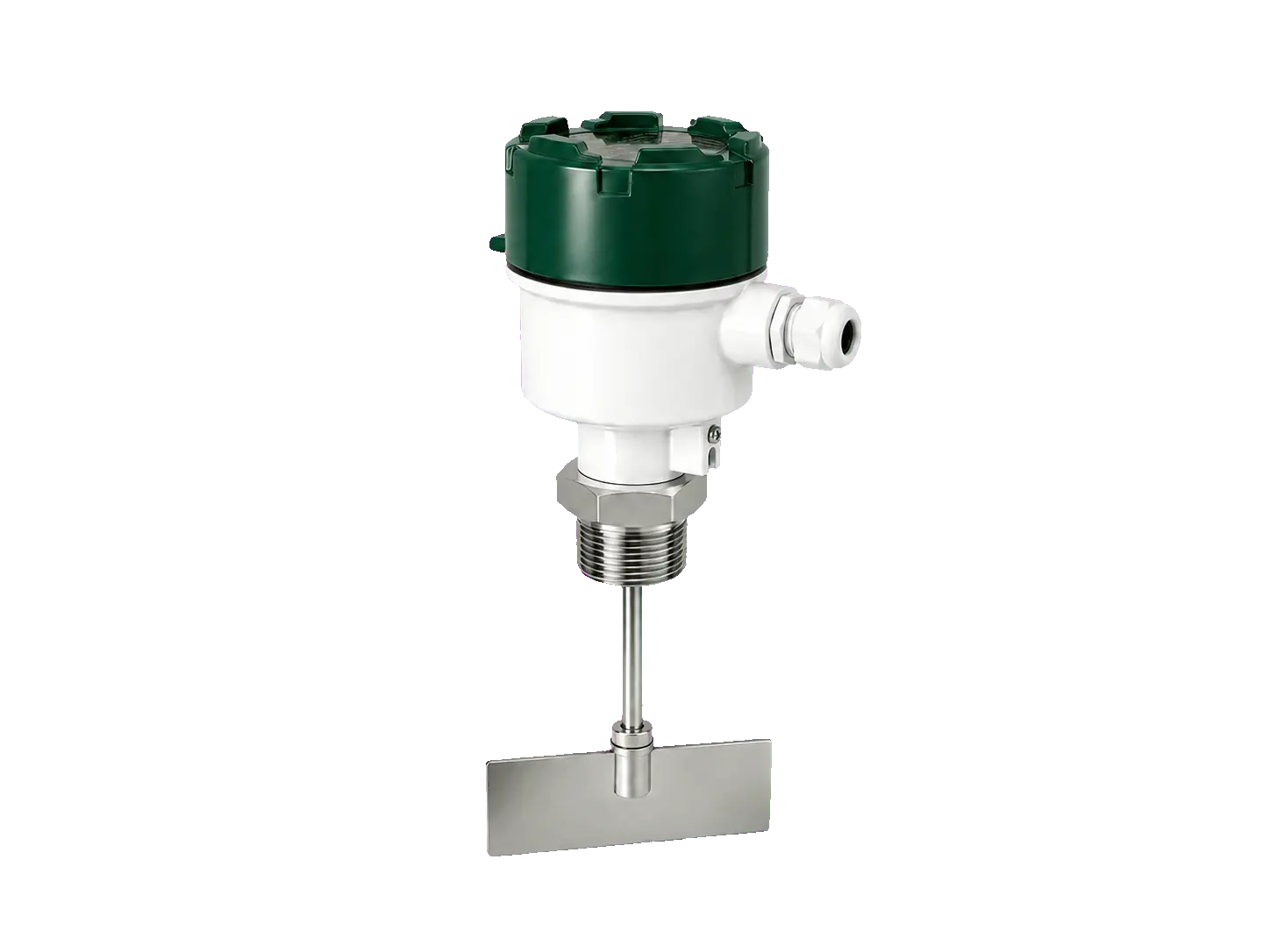
Rotary paddle level switches for high and low point-level detection of powders, grains, granules and free-flowing bulk solids in silos, hoppers and process vessels.
Rotary Paddle Level Switches are designed for reliable high- and low-level detection of powders, granules and bulk solids in silos, hoppers, bins and process vessels.
Motor-driven paddle for reliable high / low level detection
Rotary Paddle Level Switches are designed for reliable high- and low-level detection of powders, granules and bulk solids in silos, hoppers, bins and process vessels.
A motor-driven paddle rotates freely when no material is present. When the material reaches the paddle, its rotation is restricted, activating the switching mechanism and providing a level indication or control signal. The motor is automatically protected during the covered condition.
The rugged shaft-sealing arrangement helps prevent dust ingress, while multiple mounting, insertion-length and paddle configurations make the switch suitable for a wide range of bulk-solid applications.
How it works
Working Principle
A small motor rotates the paddle continuously while it is uncovered. Bulk material restrains the paddle, the resulting torque operates the switch mechanism, and the output changes to indicate the material level.
01
Paddle rotates
The motor-driven paddle turns freely when no material is present at the selected level point.
02
Material stops rotation
Powder, granules or bulk solid reaches the paddle and creates enough resistance to stall the shaft.
03
Level signal operates
The torque mechanism changes the SPDT or DPDT output and protects the motor by shutting it down during the covered condition.
At a glance
Key Highlights
Motor-driven paddle for reliable high / low level detection
Adjustable torque with motor overload protection
Rugged shaft sealing helps prevent dust ingress
Extended insertion length and flanged mounting options
Suitable for powders, granules and bulk solids
Range summary
Technical Specifications
Values below summarise the product family. Open an individual product for its complete model and variant data.
Enclosure
Die-cast aluminium
Operating Voltage
110–220 VAC / 24 VDC
Power Consumption
Approx. 3 W
Switch Output
2 × SPDT: 5 A + 1 A
Process Temperature
-20°C to 350°C
Wetted Parts
SS304 / SS316
Switching Delay
Approx. 5 s
Insertion Length
100 to 3000 mm
Mounting Connection
1″ BSP / NPT (M); customised available
Cable Entry
M20 × 1.5
Typical use
Applications
High- and low-level detection in silos and hoppers
Powder and granular material level monitoring
Overflow prevention in storage bins and vessels
Empty / low-level indication in bulk material containers
Conveyor and material transfer point monitoring
Cement, grain, plastic pellet and similar bulk-solid applications
Selection confidence
Why Choose Kuncham Controls?
Purpose-built for bulk solids
The mechanical paddle principle provides straightforward high- or low-level detection in powders and granular materials.
Protected drive mechanism
Adjustable torque and overload shutdown help protect the motor when material restrains the paddle.
Dust-resistant construction
The shaft sealing arrangement helps reduce dust entry into the enclosure.
Flexible vessel reach
Standard, flanged and extended-length versions cover small hoppers, tanks and tall silos.
Support
Questions & Answers
What materials suit a Rotary Paddle Level Switch?
It is intended for compatible powders, granules and other bulk solids in bins, hoppers and silos.
How does the switch detect material?
Material restrains the rotating paddle; the resulting torque operates the switching mechanism and protects the motor during the covered condition.
Which supply voltages are available?
110–220 VAC and 24 VDC operating options are available.
Can the insertion length be extended?
Yes. Insertion lengths from 100 mm to 3000 mm are available, including extended-length and rope-type configurations.
What information is needed for selection?
Provide the bulk material, density and flowability, vessel size, switching level, process temperature, mounting, insertion length, connection and supply requirement.